GTS-RZ9000
Wireless terminal R&D level and certification level OTA test system supporting 5G MIMO/SISO measurement
Product Description
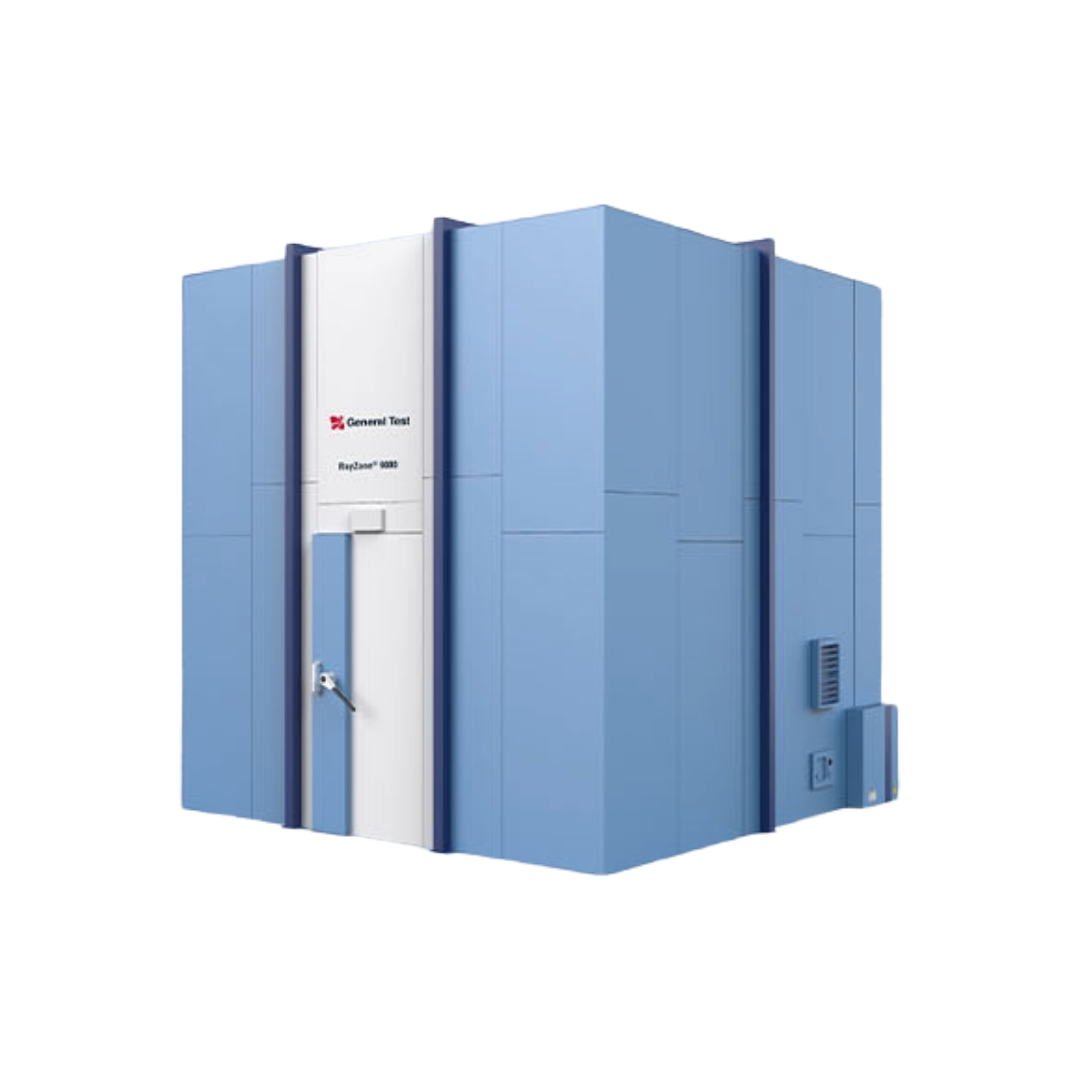
RayZone® 9000 multi-probe high precision SISO/MIMO OTA/antenna test system is the highest performance model of GTS’s star product RayZone series. Its software and hardware comply with the latest test standards of 3GPP, US CTIA and EU CE certification. GTS is also the only OTA test system supplier in China who delivered multiple CTIA certified systems. Meanwhile, the design and construction of RayZone® 9000 are based on many GTS patented-technologies with innovations in electromagnetic environment design, measurement component optimization, test algorithm optimization and system software development.
Product Functions
The hardware design of RayZone® 9000 OTA test system fully complies with the latest version of CTIA’s “Test Plan for Mobile Station Over the Air Performance” and strictly follows its prescribed calibration methods and test procedures for far-field testing conditions. In addition, RayZone® 9000 can also be extended to support other IoT product testing such as Zigbee/Lora/NB IOT, which can be achieved through additional instruments and upgraded measurement software.
Passive testing and OTA testing functions for different communication standards:
- Mobile communication 2G/3G/4G/5G FR1
- Wi-Fi 802.11b/g/n/a/ac/ax
- Bluetooth
- GNSS
- 5G NR FR1 4×4 MIMO OTA throughput testing using multi-probe method
In conjunction with the Universal Test R&S Wireless Communication OTA Test Software, the RayZone® 9000 supports fully automated testing of the following test items, including measurement indicators:
- NHPRP
- NHPIS
- MIMO Antenna Correlation
- Cross Polar Level
- Antenna Effificiency
- TIS
- 2D/3D radiation pattern
- EIRP
- EIS
- Throughput
- Gain
- Directivity
- Beamwidth
- TRP
Features
Comprehensive Distributed Antenna System (DAS)
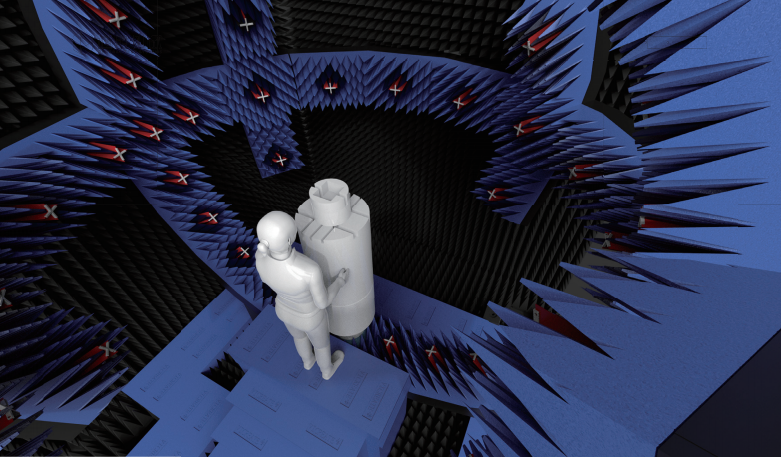
The RayZone® 9000 system uses a multi-probe antenna system architecture that allows for independent installation of probe antennas for SISO and MIMO measurements through a modular design, increasing system configuration flexibility. The modular installation not only reduces the complexity of system construction, but also improves the accuracy and consistency of system installation.
Radiation two-stage (RTS) MIMO testing
The RayZone® 9000 system supports MIMO testing capabilities based on the RTS method. For example, the RTS method is used for 4X4 MIMO testing.
EPP rigid foam absorbing material
Absorbing material is one of the most important core components of microwave anechoic chamber, and its performance and product quality have a direct impact on the overall indicators of the project. The full range of products of General Testing adopts the high-performance, environmentally friendly fourth-generation absorbing material produced based on the world’s leading technology – Polypropylene Foam (EPP) absorbing material with patented technology of General Testing, which has incomparable advantages of traditional polyurethane sponge (PU) materials.
Multi-probe method (MPAC) MIMO testing
The RayZone® 9000 system MIMO test supports both tester-based and tester-based test schemes that include only downlink one-way channel simulation to evaluate the performance of the downlink throughput of the terminal. During the test, only the 8-probe antenna or 16-probe antenna of the horizontal middle ring can be used for the evaluation test under the 2D channel model, and the probe antenna on the upper and lower horizontal double rings can also be selected for the evaluation test under the 3D channel model. There are two test scenarios for the actual base station.
Broadband Low-Scattering Dual-Polarization Measurement Probe Antenna
The measurement antenna of the RayZone® 9000 is a wideband low-scatter dual-polarized antenna (MA-2800) designed by General Purpose Testing. It can be used for gain calibration, measuring probes and generating broadband interference signals.
Multi-dimensional MIMO performance evaluation
The RayZone® 9000 MIMO test supports SIR-based throughput testing and RS-EPRE-based throughput testing. The SIR-based throughput test function mainly refers to the MIMO test standard of CTIA, which is to continuously increase the additional AWGN noise power and change the SIR of the environment where the DUT is located under the condition of the downlink power output of the fixed channel simulator, so as to evaluate the throughput performance of the DUT under different SIR conditions.
Test Software
- Supports 3D testing, 2D testing in planes, and single point testing validation.
- The test raw data and log management are well-organized and the testing process is frozen and traceable.
- Batch processing function supports the creation of task lists to achieve unattended continuous testing.
- The software has built-in rich templates, preset parameter settings fully consider the characteristics of different instruments and platforms, easy to operate, and effectively avoid misoperation.
- Supports clicking to view test data for any point.
- Provides rich test process anti-disconnection, breakpoint reconnection, and abnormal prompt settings, effectively improving the reliability and smoothness of measurements.
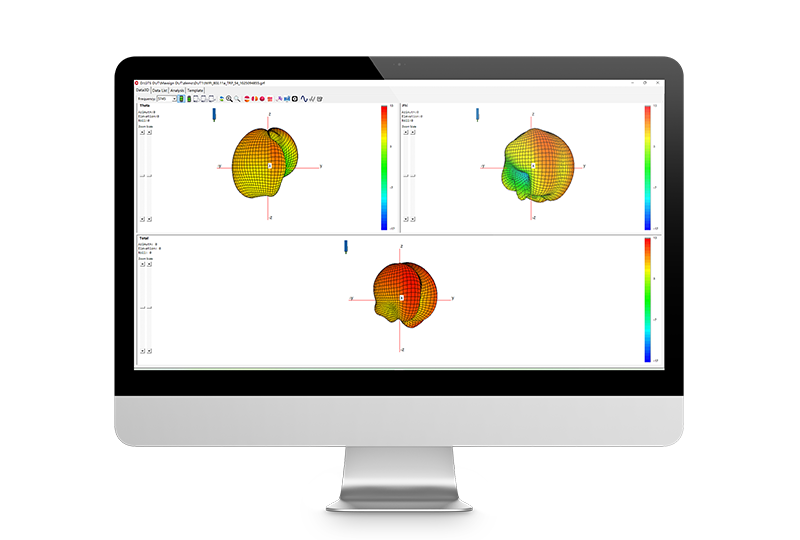
- The 3D data display software provides direction graph rotation and browsing and cutting functions from any angle to help R&D engineers intuitively analyze and diagnose problems.
- Supports freely selecting testing angle steps and testing configurations.