RayZone® 1800
OTA testing system for wireless terminals that supports 5G MIMO/SISO measurements.
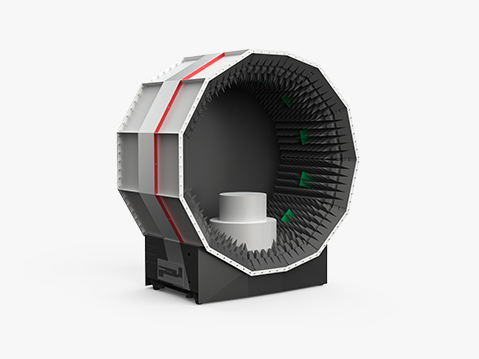
Innovative box structure with cleverly asymmetrical thirteen-sided design.
RayZone® 1800’s innovatively employed the asymmetric 13-sided polygon design. Through the 180 degree transformation of some sampling points, with only 12 test antennas, it provides a minimum angle of 15° sampling step as defined in the CTIA measurement. The asymmetric shape determines the irregular distribution of the test probes which maximizes the measurement distance within a small chamber. In addition, matching the antenna quantity with the antenna spacing helps to avoid the direct reflection and reduce the adjacent coupling between antennas.
RayZone® 1800 achieves the same measurement performance as a large certified chamber in one-fifth of the size.

Low Dispersion Antenna
As one of the key components of the OTA testing system, the low-scattering antenna is used in RayZone® 1800 to ensure the system achieves the best testing accuracy.
The antenna operates at frequencies ranging from 400MHz to 7.5GHz, and features:
- A gain flatness of ±0.25dB for every 100MHz bandwidth across the entire frequency range.
- Optimized antenna feeding to enhance standing wave performance.
- Modular design to ensure consistent antenna performance and easy installation and maintenance.
- Compact size, integrated design with surrounding absorptive foam, achieving low-scattering performance.
Absorber
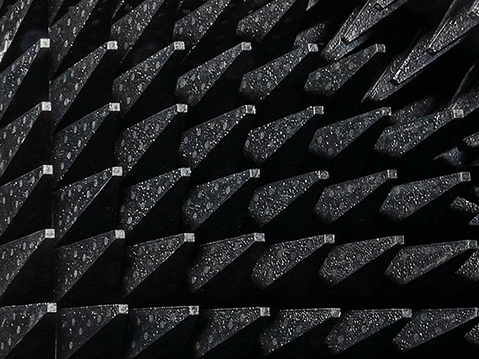
- Electrical performance: EPP has a small dielectric constant, low surface reflection, uniform material, and sufficient internal attenuation, achieving good absorption performance in the microwave band.
- Flame retardancy: Compliant with UL94 HF-1 standard.
- Oxygen index: >27%.
- Operating temperature: Long-term -50‒100℃, short-term 120℃.
- Environmental protection: Raw materials are non-toxic, odourless, and release no harmful gases or dust.
- Finished product: Stable properties, complying with RoHS requirements.
- Physical performance: One-time moulding with precise dimensions; uniform appearance color, customizable; stable product with no deformation and no maintenance needed for life.
- Antenna operating frequency: 600MHz‒12GHz.
- Gain flatness of the antenna within the entire frequency range: ≤±0.25dB.
- Other features: Optimized antenna feeding to improve standing wave performance; modular design to ensure antenna performance consistency, easy installation and maintenance; small size with an integrated design with the surrounding absorbing material to achieve low scattering performance.

Product Accuracy
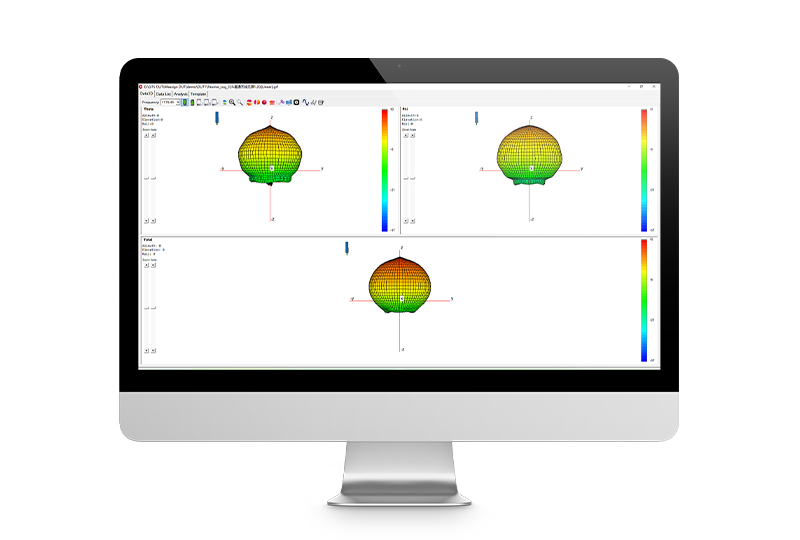
RayZone® 1800 provides antenna engineers with an accurate testing environment to ensure that small antennas can obtain real and accurate antenna patterns in different orientations in the low-frequency range. The figure below shows the test results of a standard passive antenna inside the RayZone® 1800, which is consistent with the software simulation results.
RayZone® 1800 design has passed rigorous system-level hardware simulation, with every component and detail being carefully crafted. Customized measuring antennas with wideband, low-scattering, and low-cross polarization are adopted. The EPP new-type absorption material is firm, durable, environmentally friendly, moisture-proof, and dust-free. The fully-transparent, customized fixture design can effectively reduce blockage and improve measurement accuracy. It is precisely because of the attention to detail that the testing results of RayZone® 1800 can be compared with those of large far-field testing systems. It not only agrees with the laboratory simulation results but also possesses all the testing functions of expensive and large certification-level dark rooms.
Product Advantages
The RayZone® 1800 is an extremely versatile product within the RayZone® series of general-purpose test analogue electromagnetic environment measurement systems. It is powerful, richly configured, and capable of providing testing accuracy equivalent to that of a large-scale darkroom, as well as superior testing speed and consistency.
Based on a brand-new measurement theory and system design, the RayZone® 1800 employs a unique asymmetric polygon design that cleverly multiplies the RF sampling points of the test item, achieving a perfect balance between small space and full functionality. The RayZone® 1800 fully supports SISO OTA testing and can support radiated two-stage MIMO OTA throughput testing with a pure software upgrade, making it a high-performance and cost-effective RF pre-verification test system that conforms to 4G/5G communication standards.
-
- Supports all mainstream communication standards
- Supports all required standard testing items
- Supports passive/active/head and hand testing modes
- Supports 2D/3D directional diagram display
- Supports Desense testing
- Supports a rich set of instrument configurations
- Provides rich debugging information needed for research and development
- Provides RF sampling angle density of up to 15 degrees
- Provides optimized plugins for the tested item
Test Software
-
- Supports three-dimensional testing, two-dimensional testing on planes, and single-point testing verification.
- The testing raw data and log management are well established, and the testing process is solidified and cannot be changed, while also being traceable.
- Batch processing functions support the creation of task lists and achieve unattended continuous testing.
- The software has a built-in rich template, and the preset parameter settings fully consider the characteristics of different instruments and platforms, making the operation simple and effectively avoiding erroneous operations.
- The three-dimensional data display software provides directional map arbitrary angle rotation and cutting functions, helping R&D engineers to visually analyze and diagnose problems.
- It supports free selection of testing angle step size and testing configuration. Clicking on any point of the testing data can display detailed information.
- It also provides rich testing process anti-disconnection, breakpoint reconnection, and exception prompting settings, effectively improving the reliability and fluency of the measurement.